Platform Integrations Solutions Senior Leaders Agile Coaches Product Leaders Portfolio Managers Compare Pricing Partner About Blog Login See it in action
Comparison

Jellyfish tells you where engineering effort went. Performalise tells you whether it mattered.

Last updated 27 August 2026

Jellyfish is a Gartner Leader for Developer Productivity Insight: allocation, AI impact, DevFinOps. Performalise is Product Development Intelligence: a goal ladder from vision to sprint, drift caught inside the team, and a coach who acts on it. Different questions, often the same buyer.

+33%
More successful sprints
+45%
Stakeholder satisfaction
26K+
Team improvement ideas
±4-6w
Sprint predictability
The short answer

Choose by the question you are asking

Choose Jellyfish if the question is "where does our engineering capacity and AI spend go, and how do I report it to the board or the auditors." It is built for that: allocation by initiative, AI-tool adoption and token cost, software capitalisation and R&D tax reporting, benchmarks against other companies.

Choose Performalise if the question is "which of my teams' work is actually moving the product, and who is drifting from the goal this week." It reads the standup as well as the tools, scores work against a goal ladder that runs from company vision to sprint goal, and coaches the team inside the sprint through Hans or Lotte.

Many organisations with 100+ engineers run both: Jellyfish for allocation and finance, Performalise for the team-level signal and the coaching. Below 100 engineers, most will only need one, and the deciding question is whether you want a report or a coach.

Goals, OKRs, drift and validated value

The part Jellyfish has no equivalent for

Every piece of work sits on a goal ladder from company vision down to the sprint goal. Drift shows up at the level it starts.

In Performalise every level of the ladder is a card with an owner, the teams on it, a progress figure and a status. Nobody types the status. It comes from said versus did inside the sprint and rolls up.

LevelExampleOwner · teamsStatus
Organisational VisionMake clean energy the obvious choice for every homeEleanor Whitfield · no team46% · On track
Business ObjectiveReach profitability on residential installationsCallum Reid · Installations25% · At risk
Product VisionInstallation in a single visitDaniel Hargreaves · Installations, Battery Storage25% · At risk, overdue
Product GoalOne-day battery installation kitDaniel Hargreaves · Battery Storage, Installations25% · Off track, overdue
Sprint GoalPre-wired battery cabinetteam levelOverdue
  1. Drift is caught where it starts, then rolled up. One late sprint goal becomes an off-track product goal, then an at-risk objective, on the same screen, days before a status report could say so.
  2. OKRs are translated, never cascaded. An objective becomes a sprint goal the team commits to. Performalise does not push OKRs down into tickets, and a ticket cannot claim it delivers a company vision on its own.
  3. Validated value comes from what customers actually use. The value ladder is scored from product analytics (Microsoft Clarity, Google Analytics 4, Amplitude): adoption, retention, sentiment. Shipping moves the work ladder; usage moves the value ladder. Validated is not proven until an experiment says so, and Performalise says that too.
Where Jellyfish stands: Jellyfish's Business Alignment module allocates engineering effort and cost to initiatives and reports it to finance. It answers "how much did we spend on X." It does not carry a vision-to-sprint ladder with a drift status at each level, it lists no product-analytics integration on its integrations page (checked 26 August 2026), so it cannot score whether X was used, and it does not coach the team that built X.
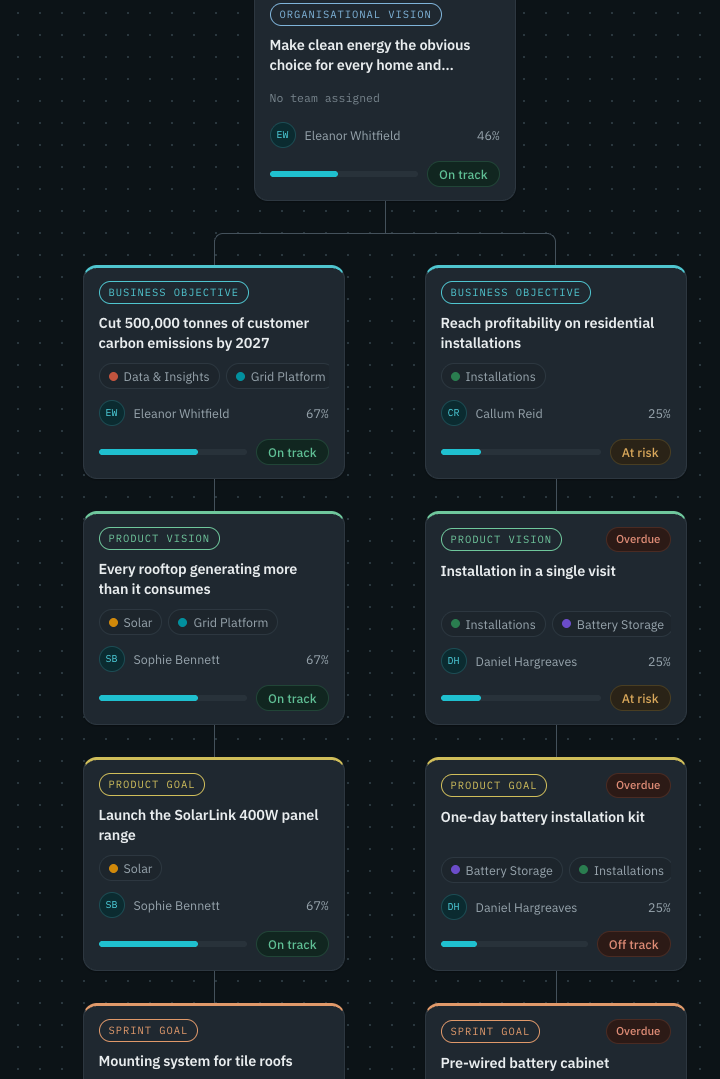
Performalise goal tree, demo data: an organisational vision at the top, two business objectives beneath it, then product visions, product goals and sprint goals, each card showing owner, teams, progress percentage and a status of on track, at risk, off track or overdue.
Demo data. The right-hand branch shows one late sprint goal rolling up to an off-track product goal and an at-risk objective.

What Jellyfish does well, and where it stops

Jellyfish is a serious platform and the market agrees: a Leader in Gartner's first Magic Quadrant for Developer Productivity Insight Platforms (May 2026), 4.5 out of 5 on G2 and Gartner Peer Insights, and integrations across GitHub, GitLab, Jira, Linear, Azure DevOps and a dozen AI coding tools. If you need to explain engineering spend to a CFO, it is one of the best ways to do it. It stops at four points that matter to a product leader:

None of that is a criticism of Jellyfish. It is the difference between engineering intelligence, which measures the organisation, and Product Development Intelligence, which measures whether the work moved the product and changes what the team does next.

The detailed comparison

Feature-by-feature: Performalise vs Jellyfish

Capability Jellyfish Performalise
Reads the standup (Teams, Slack, Google Meet) Yes
Reads tickets (Jira, Azure DevOps, Linear) Jira, Linear, Azure Boards Yes
Reads code and deploys GitHub, Azure DevOps, CI tools GitHub, Vercel, Supabase
Said versus did (commitment vs outcome, daily) Yes
Coaching inside the team, every sprint Hans or Lotte
Work scored against OKRs at team level Yes
Goal ladder: Organisational Vision → Business Objective → Product Vision → Product Goal → Sprint Goal Initiative allocation Yes, with owner, teams, progress and status per level
Drift detected in the sprint and rolled up (on track / at risk / off track / overdue) Yes, daily
OKRs translated into sprint goals, never pushed into tickets Yes
Validated value from product usage (Clarity, GA4, Amplitude) Yes
Delivery forecast as a range with confidence Deliverable timelines ±4-6 weeks across a portfolio
DORA and SPACE metrics Yes, with cross-company benchmarks DORA as one input, no cross-company benchmarks
AI coding-tool adoption and token-cost reporting Yes (AI Impact module)
Software capitalisation and R&D tax reporting Yes (DevFinOps)
Individual developer scoring Per-person metrics available Deliberately absent, patterns not people
Pricing basis Per seat and per module, quote only Per team, from $450/team/month (annual)
Two different jobs. Jellyfish measures the engineering organisation: effort, spend, AI adoption, finance. Performalise measures whether the work moved the product, catches drift inside the team, and coaches. Both read Jira and GitHub; only one reads the standup. See also: the 2026 shortlist of delivery intelligence tools →
Fit check

Who is Performalise not for?

We would rather tell you now than after a sprint. Performalise is not the right fit if:

  1. You want individual productivity scores. We measure patterns, not people. There are no per-person leaderboards, and we will not build them.
  2. Your teams do not work in Jira, Azure DevOps or Linear. Those are the front doors today. Other trackers are also supported, just talk to us.
  3. You want a dashboard and no coach. The signal only becomes value when the AI Coach Hans or Lotte act on it inside the team. If nobody wants coaching, you would be paying for reports, which would be sad.
  4. You want velocity as a productivity target. Velocity is a planning signal for the team that owns it. We will not turn it into a KPI or compare it across teams.
  5. You measure success in output. Story points closed, tickets shipped, commits per week. We tie work to outcomes: usage, retention, OKR movement. If output is the scoreboard, the signal will keep disagreeing with it.
  6. You want OKRs pushed down into tickets. We translate an OKR into a sprint goal the team commits to. We will not cascade OKRs as task lists.
  7. You want a date, not a range. Forecasts arrive as ranges (±4-6 weeks across a portfolio) with the confidence behind them. If a single promised date is required, we will disappoint you honestly rather than precisely.

If none of those apply, see it in action →

When to use each

Jellyfish vs Performalise

Different questions. Sometimes the same buyer.

Jellyfish is built for:

Engineering intelligence for the CTO and the CFO.

  • Allocation of effort and cost by initiative
  • AI-tool adoption and token spend
  • DORA and SPACE with benchmarks
  • Software capitalisation, R&D tax credits
  • Developer experience surveys
  • Board and finance reporting

Performalise is for:

Product Development Intelligence for leaders who want a signal they can act on.

  • Goal ladder from vision to sprint goal
  • Drift caught inside the team, daily
  • Coaching through Hans or Lotte
  • OKRs translated, never cascaded
  • Value validated from product usage
  • Forecasts as ranges you can defend

Running both:

Common above 100 engineers. Jellyfish for the money, Performalise for the goal.

  • No overlap on standups or coaching
  • Overlap on DORA; pick one as canonical
  • Jellyfish for finance and auditors
  • Performalise for teams and product leaders
  • Both read Jira and GitHub read-only
  • Neither replaces your tracker
The impact

What Performalise changes

+33%
More successful sprints with predictable delivery
+45%
Improvement in stakeholder satisfaction
26K+
Ideas (single client)
±4-6w
Sprint predictability tightened from ±months
FAQs

Questions about comparing Performalise and Jellyfish

Does Performalise replace Jellyfish?
Not for finance. If you use Jellyfish for software capitalisation, R&D tax reporting or AI token-cost tracking, Performalise does not do those and does not plan to. If you use Jellyfish mainly to see whether teams are delivering the right things, Performalise answers that question more directly, from the standup and the goal ladder rather than from allocation reports.
Can we run Jellyfish and Performalise together?
Yes, and organisations above roughly 100 engineers often do. They read the same Jira and GitHub data read-only, so there is no conflict. The practical split is Jellyfish for the CFO and the board, Performalise for product leaders, coaches and the teams themselves. Pick one system as canonical for DORA so you are not reconciling two numbers.
Does Performalise track AI coding-tool adoption?
No. Performalise does not measure Copilot, Cursor or Claude Code usage, token cost or per-tool ROI. It measures whether the work those tools produce moves the goal. If AI-impact reporting is the job, Jellyfish's AI Impact module is built for it.
Does Jellyfish connect sprint work to OKRs?
Jellyfish's Business Alignment module allocates engineering effort and cost to initiatives, which is a cost view of alignment. It does not, as far as its public site shows, carry a goal ladder from company vision to sprint goal with a status at each level, and it has no product-analytics input to validate whether an initiative was used once shipped. Performalise does both, and translates OKRs into sprint goals rather than cascading them into tickets.
Which is right for a 10-team organisation?
At 10 teams (roughly 60 to 90 engineers) most organisations need one platform, not two. If the pressing question is spend and AI ROI for the board, Jellyfish. If it is delivery drift, goal alignment and getting teams to improve sprint over sprint, Performalise. Performalise at 10 teams is $4,500 a month on the Perform plan billed annually, with every coach and stakeholder included.
How is Performalise priced compared with Jellyfish?
Jellyfish is priced per seat and per module and does not publish list prices; third-party purchase data (Vendr, 91 contracts, July 2026) puts the median annual contract around $36,000 with a floor near $16,500 for the smallest deals. Performalise is priced per team, from $450 per team per month billed annually, with no per-user charge. For a 6-team, 50-engineer organisation that is $32,400 a year, in the same band as a typical Jellyfish contract, with coaching included.
Ready to see the goal, not just the spend?

See Performalise on your own teams' work

Thirty minutes, your tools, your data. Watch the goal ladder fill from your Jira, your standups and your deploys, and see where drift is already showing.

Ask Lotte anything about Performalise
Lotte

Your teams already know what’s blocking them. Want to hear it sooner?

Lotte
Your Performalise guide